
Key to to Ponerinae genera in the southeastern United States (based on workers)
|
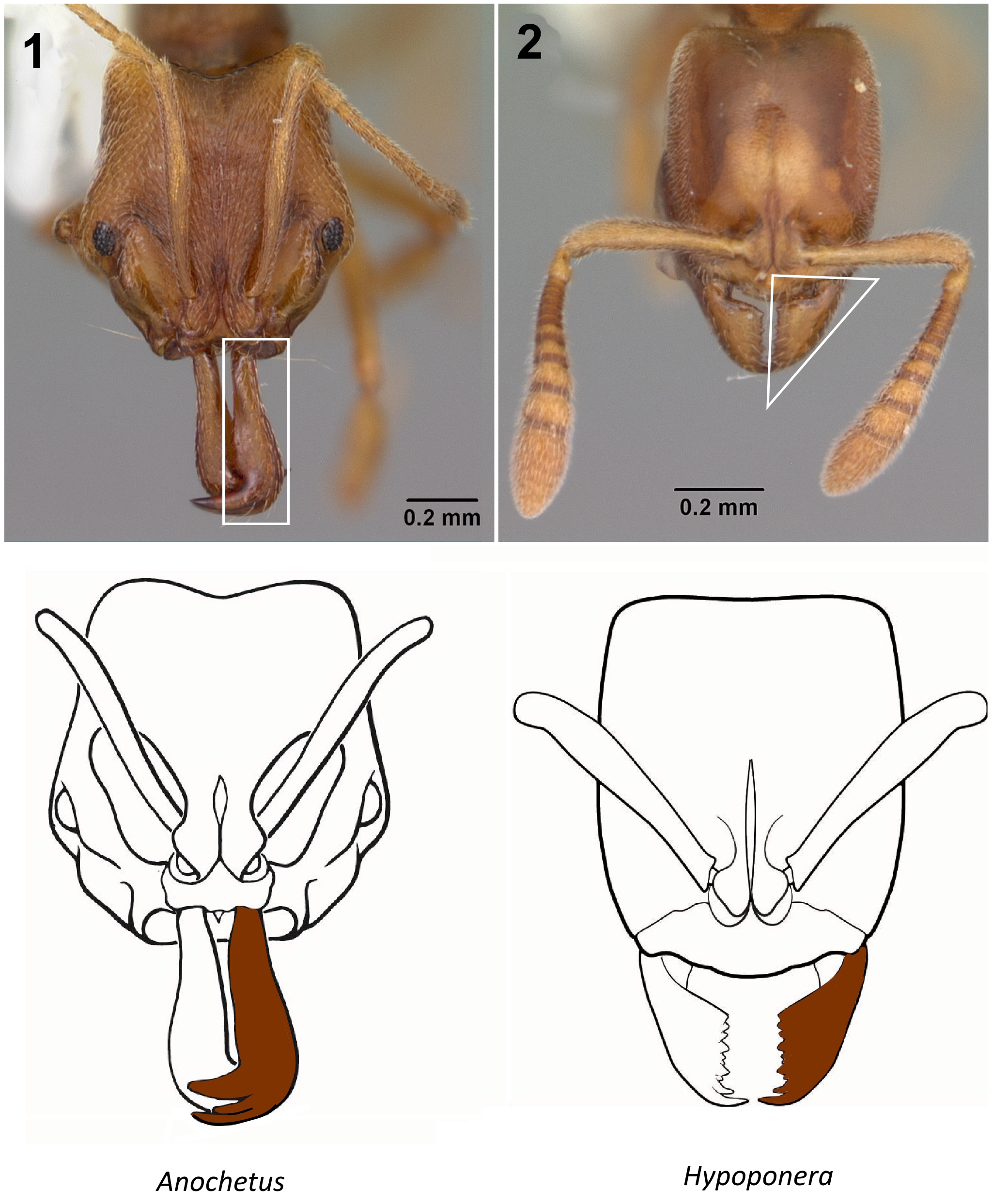
1. Mandible elongate and linear in full-face view, inserted near the midpoint of the anterior clypeal margin; apices abruptly incurved, with 2–3 teeth arranged in a vertical series; mandibular bases closely approximated (Fig. 1) …2 – Mandible linear to triangular, inserted at the anterolateral corners of the head; apices without a vertical series of teeth; mandibular bases distinctly separated (Fig. 2) ...3
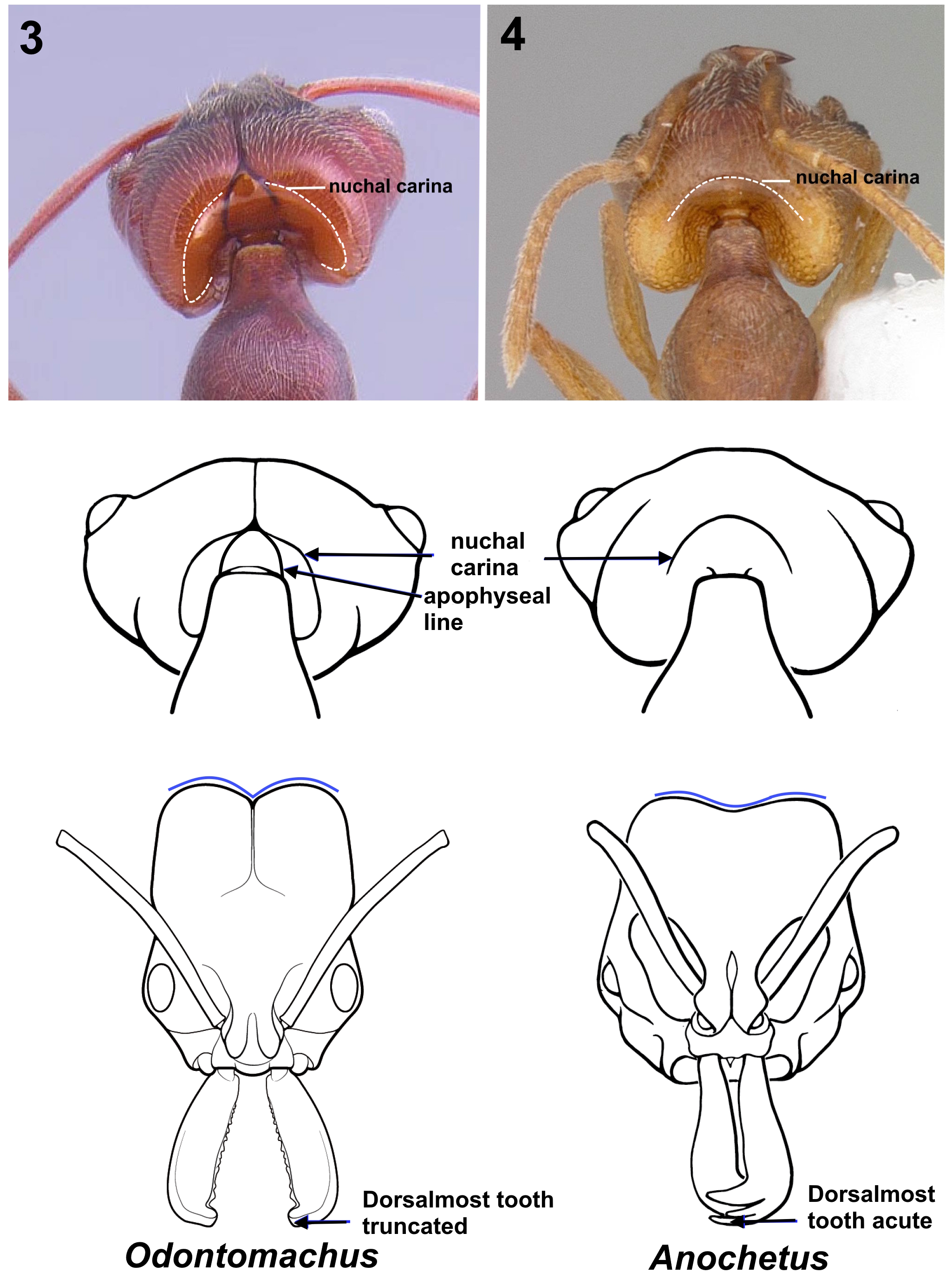
2 (1). Nuchal carina converging medially, forming a distinct V-shaped posterior head margin; posterior head surface with paired dark apophyseal lines converging into a sharp median dorsal groove on vertex; dorsalmost tooth of apical mandibular series usually truncated (rarely acute) (Fig. 3) ... Odontomachus – Nuchal carina broadly rounded, forming a continuous curve across posterior head margin; posterior head surface without paired apophyseal lines; median dorsal groove absent or shallow; dorsalmost apical mandibular tooth acute (Fig.4) ... Anochetus mayri
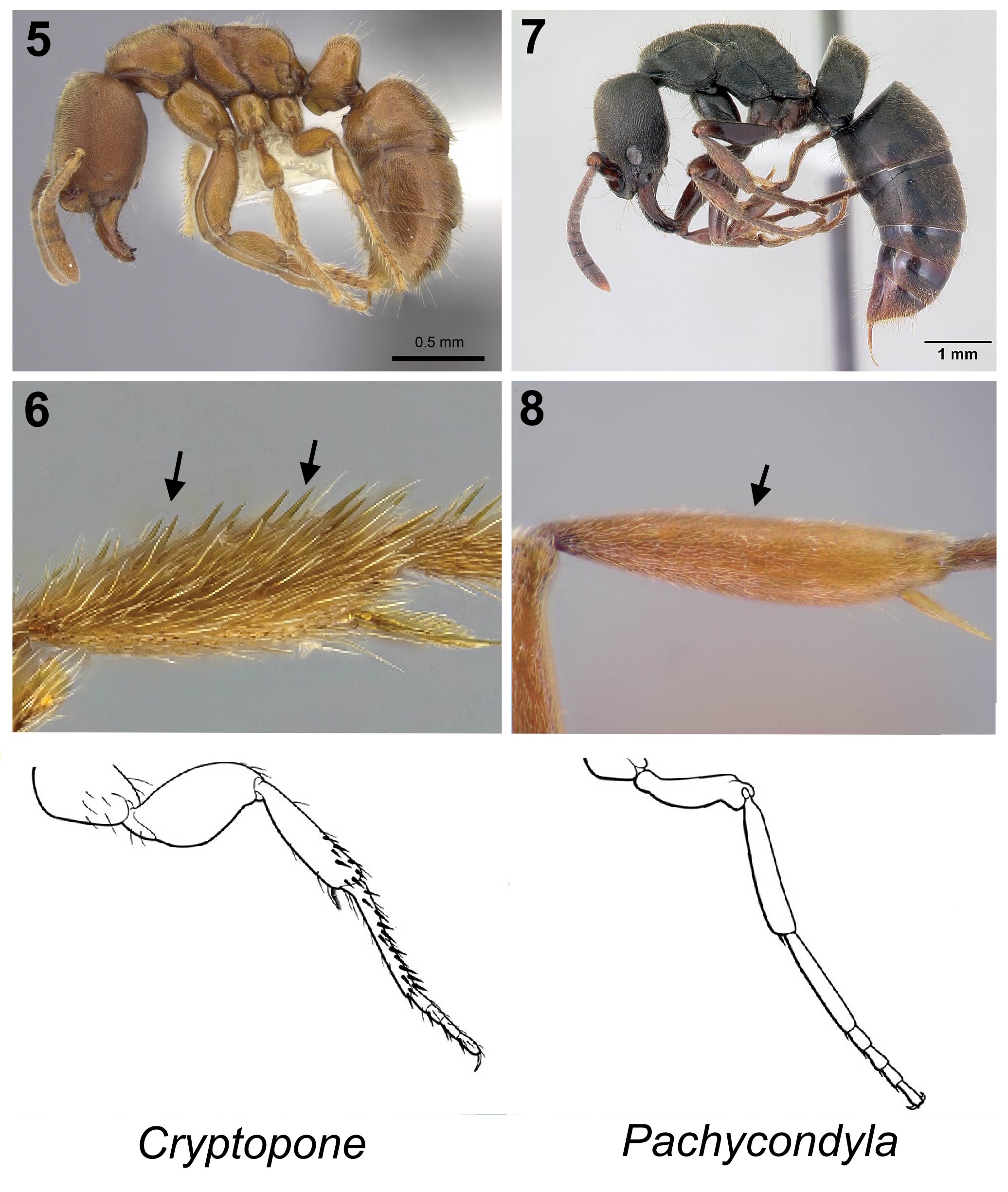
3 (1). Eye minute (maximum diameter ≤ 0.04 mm) (Fig. 5); mesotibia dorsally with numerous stout traction setae extending along most of tibial length (Fig. 6 ) ...Cryptopone gilva – Eye variable (Fig. 7); mesotibia dorsally without numerous stout traction setae (at most a few stout setae near tibial apex, not extending along tibial length) (Fig. 8) ...4
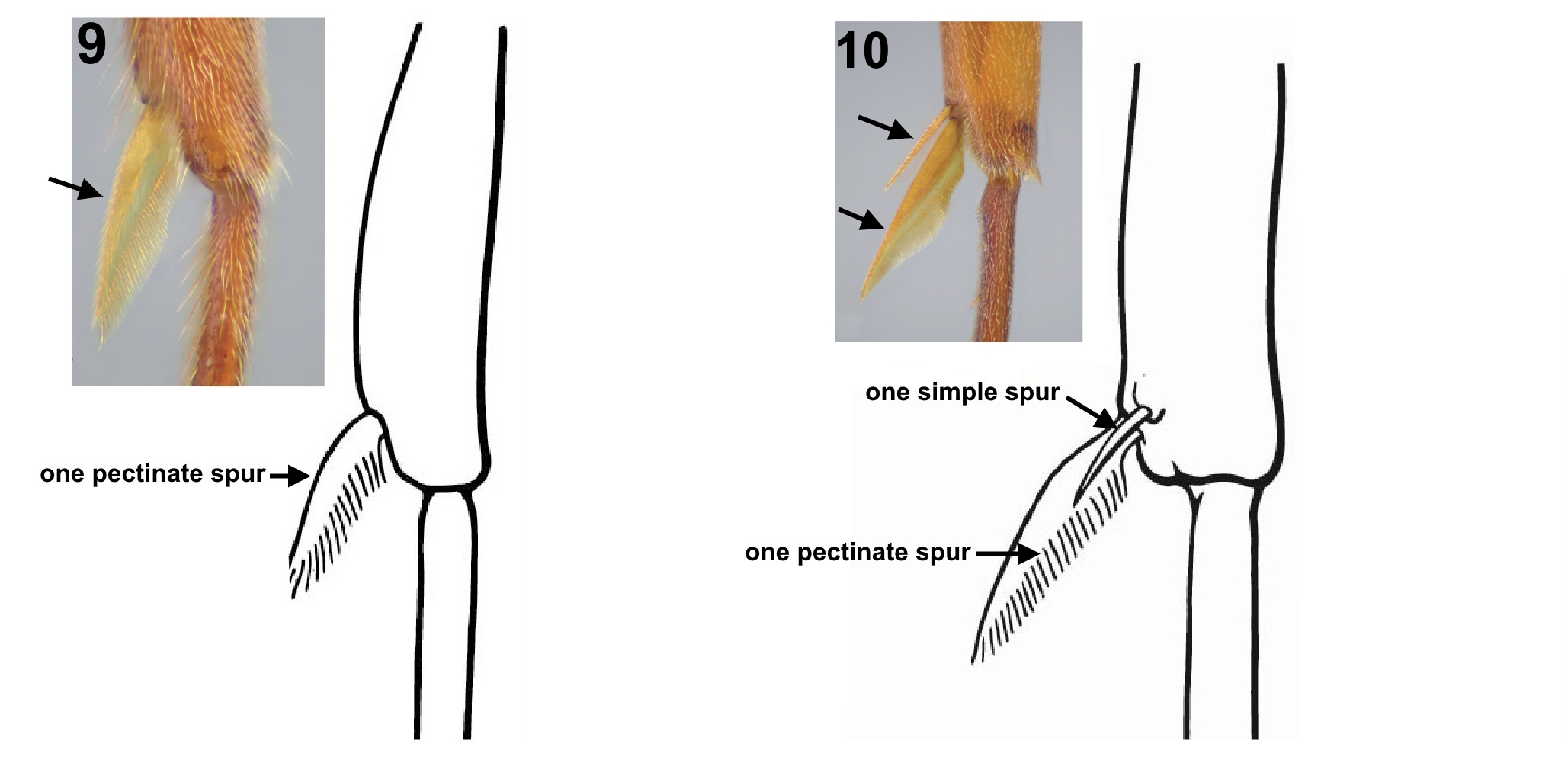
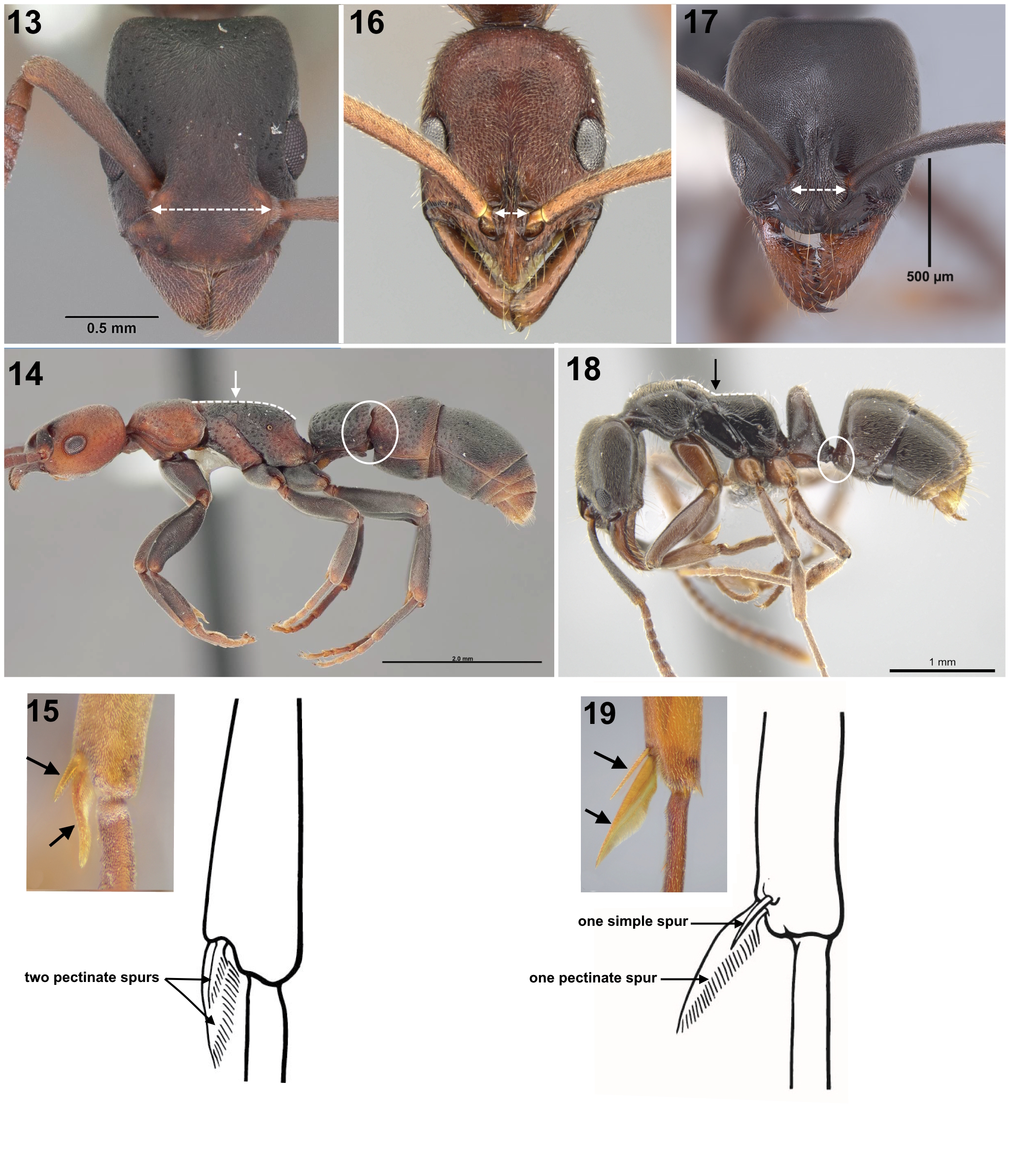
4 (3). Small ants, total length ≤ 3 mm; inner apex of hind tibia (anterior view) with a single large pectinate spur, without a second smaller spur anterior to it (Fig. 9) ... 5 – Larger ants, total length > 4 mm; inner apex of hind tibia (anterior view) with two spurs: either both pectinate (one large, one small) (AA), or one large pectinate spur and a much smaller simple spur (Fig. 10) ... 6
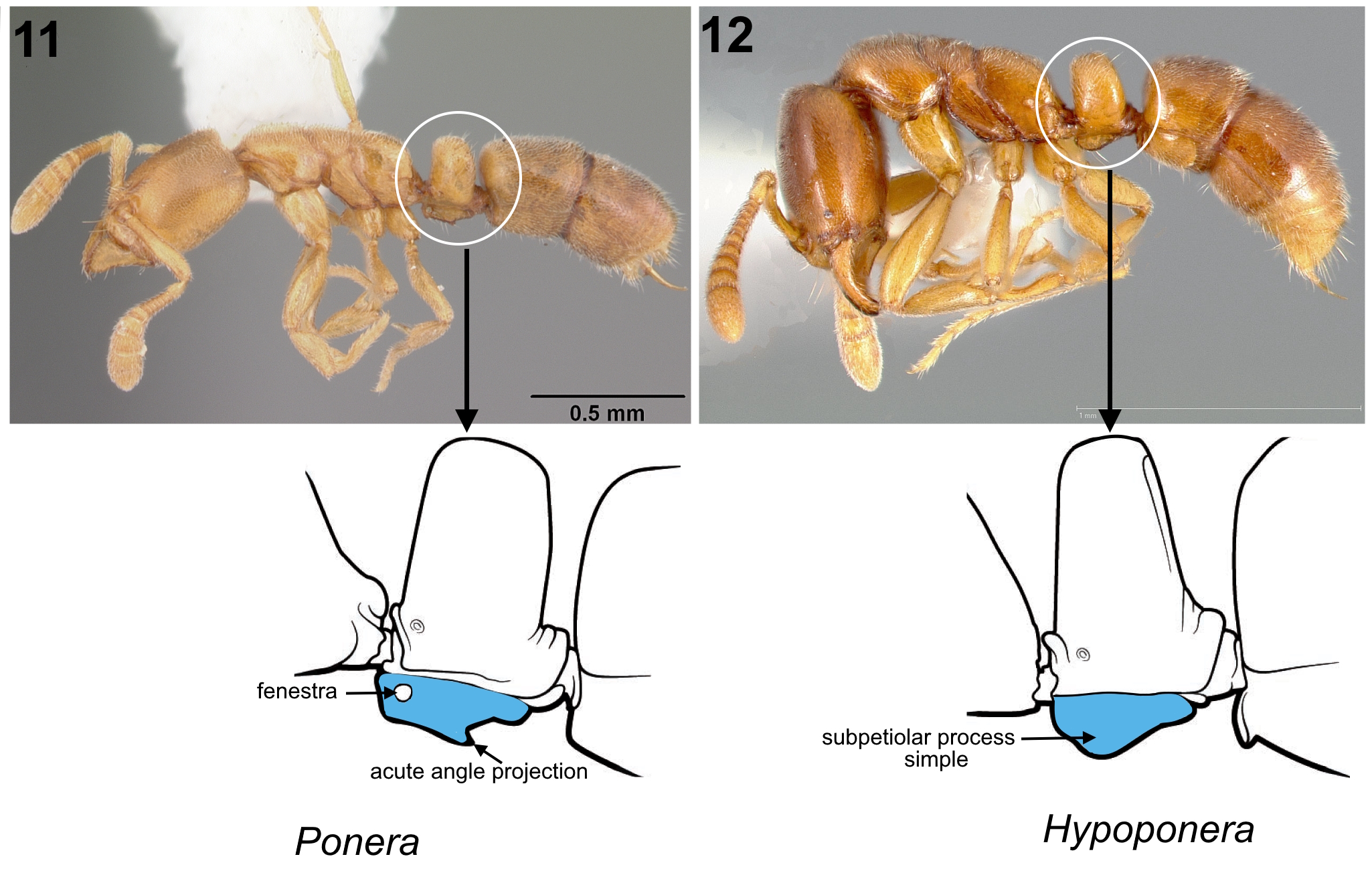
5 (4). Subpetiolar process in profile with an acute posteroventral angle and with an anterior translucent fenestra (circular thin spot) (Fig. 11); maxillary palp 2-segmented ...Ponera – Subpetiolar process in profile a simple lobe, without an anterior fenestra or translucent thin spot (Fig. 12); maxillary palp 0–1 segmented ... Hypoponera
6 (4). Antennal sockets widely separated; frontal lobes flattened in full-face view (Fig. 13). Promesonotal suture present, metanotal suture absent; petiole elongate-rectangular in profile, longer than high, broadly attached to gaster (Fig. 14). Mid and hind tibiae each with two pectinate spurs (one large, one small) (Fig.15) ... Platythyrea punctata (rarely collected; southern Florida and extreme southern Texas) – Antennal sockets closely approximated; frontal lobes not flattened (Fig. 16-17). Both promesonotal and metanotal sutures present; petiole not elongate-rectangular in profile (Fig. 18). Mid and hind tibiae each with two spurs: one large and pectinate, the other small and simple (Fig. 19) ... 7
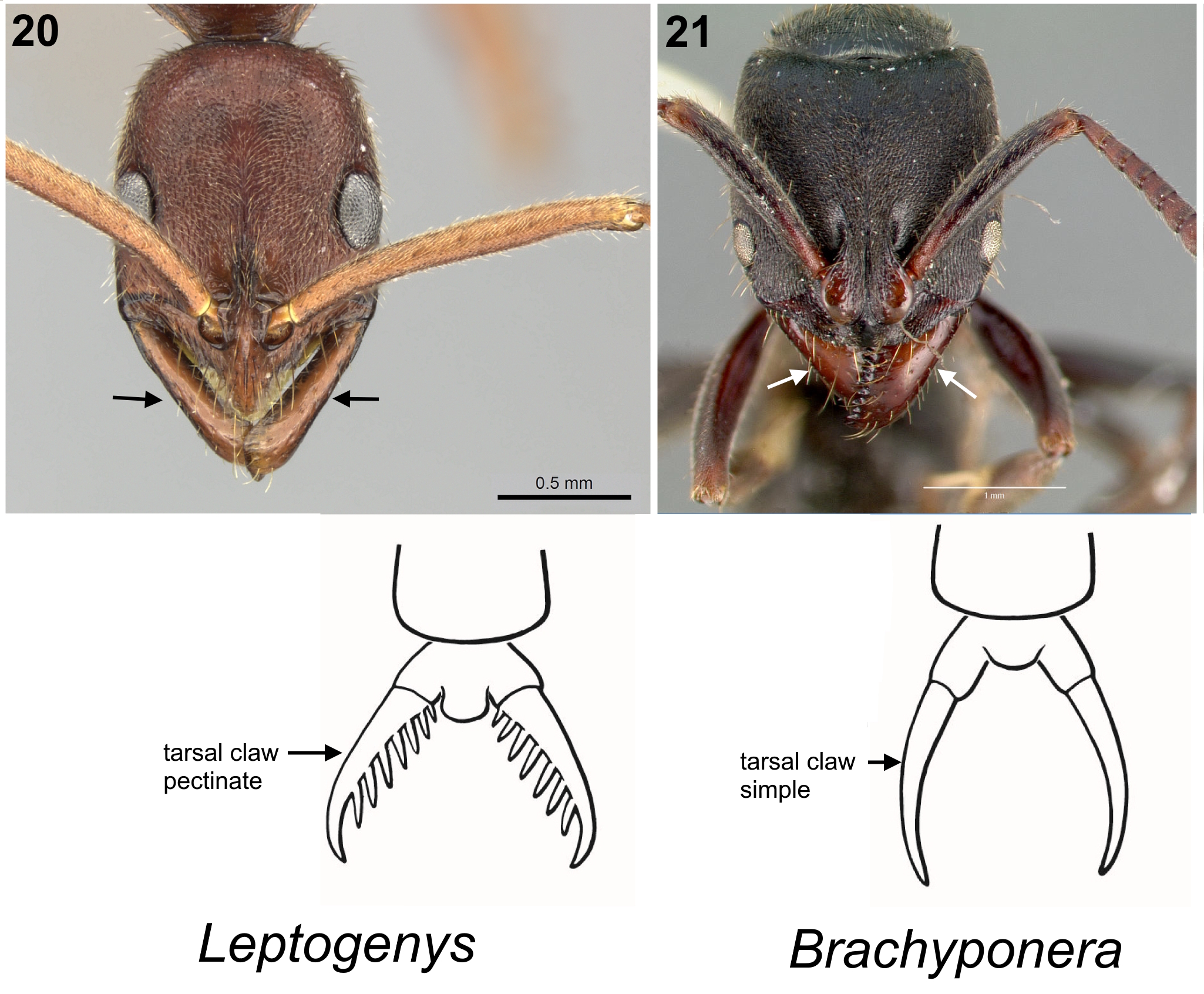
7 (6) Mandible slender and elongated and without teeth on inner margin (Fig. 20). Tarsal claws on the hind legs finely pectinate … Leptogenys - Mandible always subtriangular and armed with teeth (Fig. 21). Tarsal claws on hind legs simple, without teeth on inner margin …8
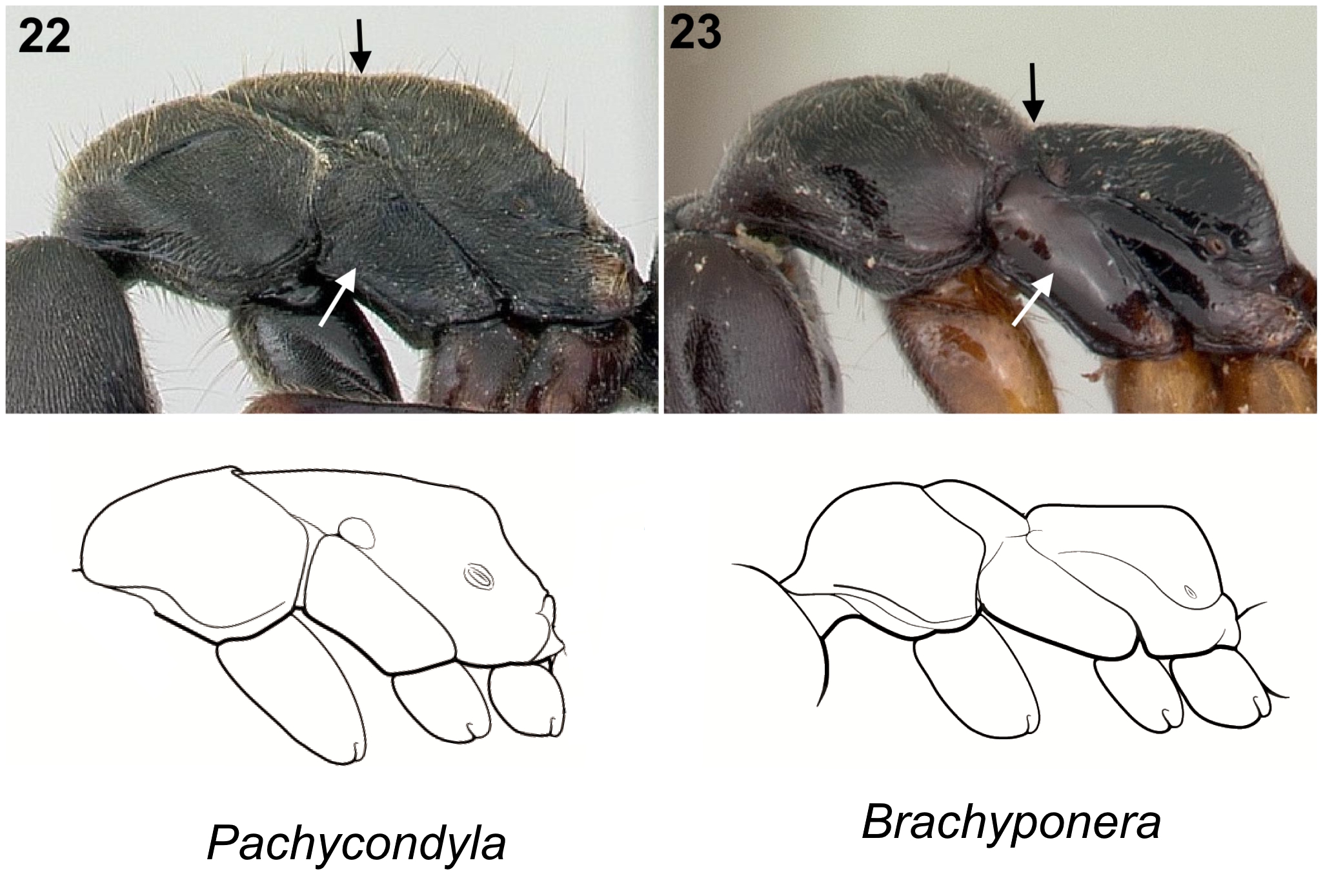
8 (7) Mesosoma robust; dorsal outline in profile evenly and continuously convex from pronotum to propodeum, without a distinct metanotal impression; propodeum broadly rounded (Fig. 22) ... Pachycondyla harpax – Mesosoma more elongate and less evenly convex; dorsal outline with a distinct metanotal impression separating mesonotum and propodeum; propodeum more flattened to weakly angulate posteriorly (Fig. 23) ... Brachyponera chinensis
|


MEM | Research Taxa | Introduction | Faunal Lists | Identification | How to Use the Keys | Glossary | Collecting Tips | Specimen Preparation MEM Publications | MEM Ant Publications | Ant Videos | Ant News | MEM Ant Blog | References | Acknowledgments | Links
Author-Joe MacGown: jmacgown@entomology.msstate.edu
The ant web site was uploaded on 6 March 2003 and was last updated on 11 September 2024
(specific pages may have different uploaded and updated dates)
Drawings and photographs by Joe MacGown (unless otherwise noted) and copyrighted by the Mississippi Entomological Museum
The development of this web site was supported in part by the National Institute of Food and Agriculture, United States Department of Agriculture, under Project No. MIS-012040 and the USDA-ARS Areawide Management of Imported Fire Ant Project (Richard L. Brown, Principal Investigator).