
Subfamily MYRMICINAE |
 |
|
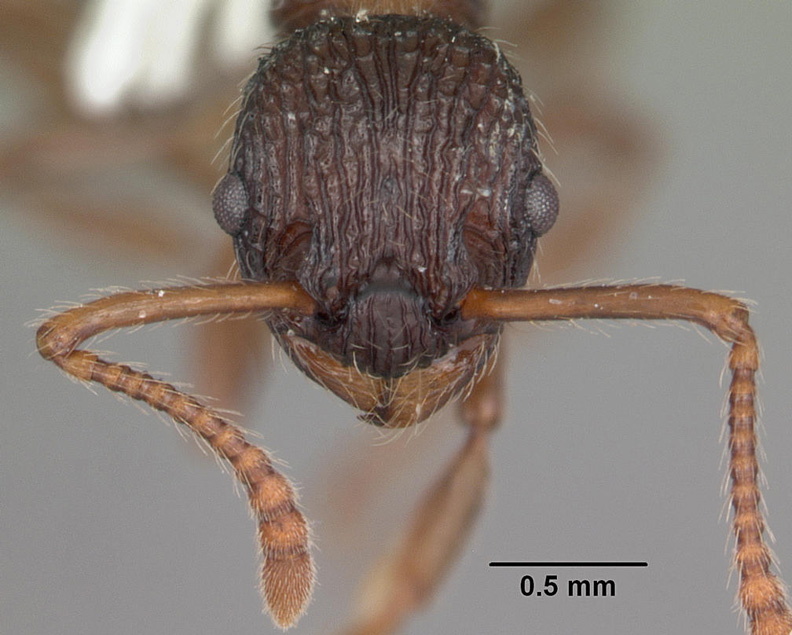
Myrmica punctiventris, full face view of a worker (click image to enlarge). Photo courtesy of http://www.antweb.org/ |
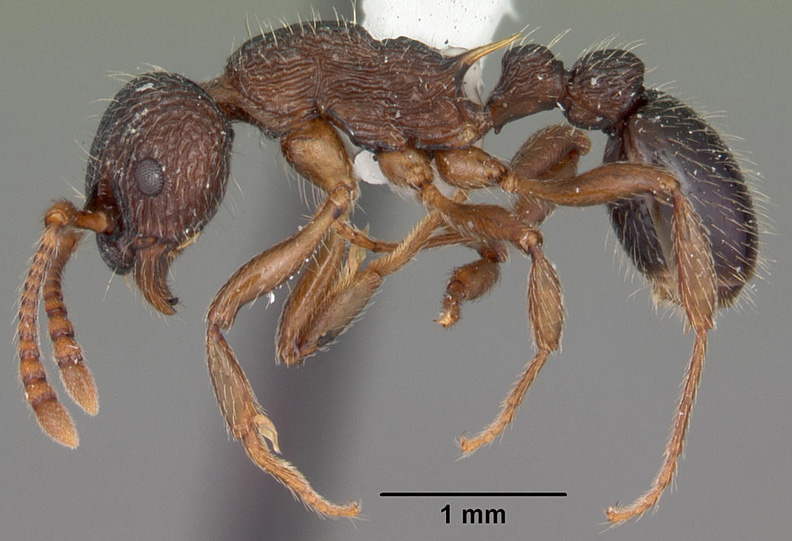 |
Myrmica punctiventris, side view of a worker (click image to enlarge). Photo courtesy of http://www.antweb.org/ |
Diagnosis.Worker: Medium sized (TL ≈ 4.0–4.7 mm); shiny; head with deep rugae and reticulation, body and waist with deep rugae; entire body dark reddish brown, antennae and legs yellowish brown; entire body with numerous, erect white setae; appressed pubescence sparse; head longer than wide; mandibles triangular with 7–8 teeth; frontal lobes expanded, covering antennal base in frontal view; antenna elongate with 12 antennomeres with apical club of 3 antennomeres; eyes large, located at midpoint of head; ocelli lacking; in profile promesonotum contiguous dorsally, promesonotal suture distinct on sides but not dorsally; metanotal groove distinct; propodeum with long paired spines that are curved and directed posteriorly; waist two segmented; petiole pedunculate, with anterior directed subpetiolar projection; postpetiole globular, convex ventrally; sting present. Queen: Similar in appearance to workers, but slightly larger (TL ≈ 5.5-6.5 mm); eyes enlarged, ocelli present; mesosoma enlarged, with wings or wing scars; wings when present hyaline with brownish tint; stigma and basal, discal, and submarginal cells present. Male (photos unavailable, description from Francoeur 2007): Smaller than queen; brown; body generally shiny, with punctate and fine rugulate sculpture mostly limited to head, dorsum of pronotum and mesoscutum, and upper metapleuron; entire body with short, erect light colored setae; head slightly longer than wide; mandibles elongate, triangular, with 5–6 teeth; frontal lobes weakly developed, appearing as thin carinae; 13 antennomeres, scape short; with 5-segmented club; eyes large, globular; ocelli small; mesosoma entire; propodeum with small protuberances; wings dusky brown with stigma and basal, discal, and submarginal cells present. Similar species. In the southeastern USA, Myrmica punctiventris is most similar to M. pinetorum Roger, which differs by being smaller, yellowish brown, and having slightly shorter, straighter propodeal spines that are directed upward. Other species in the region differ by the frontal lobes barely or not covering antennal insertions, or if having enlarged frontal lobes then base of antenna is abruptly bent at a right angle. Biology/Habitat. Myrmica punctiventris is widespread in open conifer, deciduous, and mixed forests in eastern North America. Colonies are in the soil and occasionally in dead wood and are relatively small, usually with less than 50 workers. Pest Status. This species is not considered to be a pest species. |


MEM | Research Taxa | Introduction | Faunal Lists | Identification | How to Use the Keys | Glossary | Collecting Tips | Specimen Preparation MEM Publications | MEM Ant Publications | Ant Videos | Ant News | MEM Ant Blog | References | Acknowledgments | Links
Author-Joe MacGown: jmacgown@entomology.msstate.edu
The ant web site was uploaded on 6 March 2003 and was last updated on 11 September 2024
(specific pages may have different uploaded and updated dates)
Drawings and photographs by Joe MacGown (unless otherwise noted) and copyrighted by the Mississippi Entomological Museum
The development of this web site was supported in part by the National Institute of Food and Agriculture, United States Department of Agriculture, under Project No. MIS-012040 and the USDA-ARS Areawide Management of Imported Fire Ant Project (Richard L. Brown, Principal Investigator).